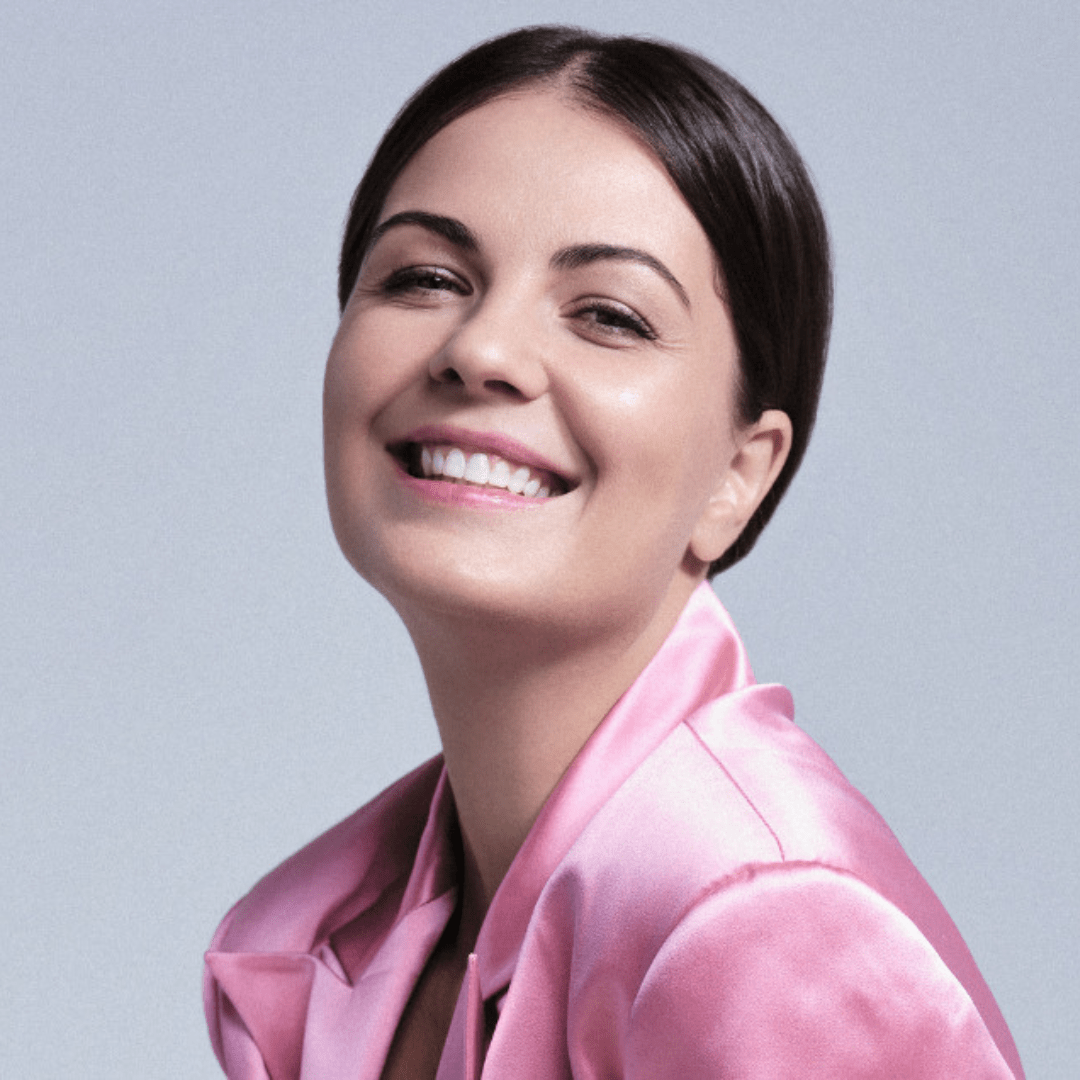
Psychologist, author, motivational speaker
Master of Applied Positive Psychology, University of Pennsylvania ’24
Master of Arts in Happiness Studies, Centenary University ’24
Master’s Diploma, Psychology, Taras Shevchenko National University of Kyiv ’12
Master’s Diploma, Marketing, Kyiv National University of Technologies and Design (KNUTD) ’06
Bachelor’s Diploma, Marketing, Kyiv National University of Technologies and Design (KNUTD) ’05
“I learned about positive psychology probably 15 years ago,” begins Ukrainian psychologist Alla Klymenko (MAPP ’24). When she started reading books about the science of happiness by Penn’s Dr. Marty Seligman, she was inspired. “I can't say that I was a super happy person or positive thinker or optimist,” she shares. “That's why, when I found those books by Marty, I thought, ‘Okay, I totally need this.’ I just felt that happiness was my topic—something I would like to know more about and move forward with.”
Alla was so motivated that she decided to pivot from a successful promotion and events career to a career promoting well-being in others.
Though she dreamed of studying under Marty’s guidance in the Master of Applied Positive Psychology (MAPP) program at Penn, it wasn’t a realistic prospect at the time. Instead, she earned a master’s in psychology in Kyiv and launched her own happiness-focused business called Upgrade.
“Our mission was to create a critical mass of happy people,” she explains. Upgrade offered in-person and online happiness programming in an edu-tainment style. “Positive psychology was a totally new topic in Ukraine, so I was kind of a pioneer,” she says. For over a decade, Alla’s business blossomed and expanded. She saw profound transformations in program participants’ lives, helping them achieve health goals, start businesses, repair relationships, and generally thrive.
The February 2022 invasion of Ukraine, however, altered Alla’s circumstances drastically. Scheduled to present at a conference in the States in March, she left her home on the eve of war. “I came here to Miami to speak at the World Happiness Summit with a small suitcase and I’ve stayed for two and a half years now,” she shares. “The plane landed here, and the war started there.”
A few weeks later at the summit, Alla had the chance to meet Marty for the first time. “He asked, ‘Do you think there is anything that we can do for Ukrainians?’ and I said ‘Of course! Let us do a course on positive psychology for Ukraine.’”
Together with Marty and other members of the positive psychology community whom she’d read about, Alla spent the next year creating an online course, translated into Ukrainian and offered free for participants inside Ukraine. It launched to great success. “Almost 100,000 people studied with this program,” she says. The course included interviews with positive psychology experts and tasks for participants to complete to help them deal with the hardships they were experiencing.
During her time in the States working on the course, Alla’s expectation, like so many others, was that the war would end soon and she could return home. Using a Ukrainian expression, she says, “I was literally sitting on my bags, waiting to go back.” As more time passed, however, her perspective began to shift. “I started to think ‘maybe I should apply for MAPP,’” she remembers. Her temporary home in Florida put her in the same time zone as Philadelphia and only a two-hour flight away, making it feasible to participate in the program’s hybrid model delivery. “It was my dream for many years, and now it’s a huge opportunity.”
Wanting to explore every opportunity to make the program possible, she reached out to program director and faculty member James Pawelski, PhD, who suggested she apply for the Christopher Peterson Memorial Fellowship
“When I found out I’d received it, it felt like a miracle,” she says. “It made my journey to Penn not just possible, but profoundly meaningful.”
Alla immediately felt a profound sense of community at MAPP. During the August orientation, she explains, James said three things to students: You belong here. You are needed. Trust the process. “Probably these three phrases were the most impactful for me,” Alla starts. “I had never heard the phrase ‘you belong here’ before! There is no such phrase in the Ukrainian language. This sense of belonging was a lot for me.”
The phrase ‘you are needed,’ perhaps, touched her the most. “That was a huge idea that impacted my professional life and my personal life,” she shares. “At the time, when I left my country, I thought my topic of happiness was maybe inappropriate, and my work was not needed anymore. Then someone tells you ‘You are needed’—It gave me more confidence in what I’m doing,” she says, referring to her ongoing support of her country through fundraising, providing online lectures on hope and resilience, and donating gratitude journals for women on the front line.
Finally, ‘trust the process,’ she says, helped quell her fears about taking on a fast-paced master’s program with the additional challenge of studying in English. “It probably took me more time than a native speaker to read and then understand and then write,” she says, but unlike past academic experiences, she never felt scared by a tough assignment or intimidated by an instructor. The entire program team, she says, was encouraging and always available to help—whether by email, text, Zoom, or in person.
As she worked through the year-long program, she also discovered that the course assignments helped her to feel and work through her own emotions about the war and her personal circumstances. “All of my words and ideas were dedicated to Ukraine,” she shares.
For her spring semester service learning project, she and a small team of fellow MAPPsters worked with Build One Community (B1C), a nonprofit organization in Connecticut that serves immigrants. Her team developed a workshop and workbook for B1C staff, combining tasks, reflections, and group projects, to build their resilience.
Alla’s capstone project targeted psychological richness development. “I created a deck of cards—52 cards for 52 weeks—to make your life psychologically rich in one year,” she says. Psychological richness is the third part of happiness, after meaning and enjoyment, she explains, which involves building different types of experiences to make your life fuller. Her instructional cards guide reflection on an individual’s past, present, and future, evaluating both positive or ecstatic events and negative or traumatic events, to help build a rich life.
Reflecting on the richness of her year at Penn, Alla describes the MAPP program as transformative. “I’m in the middle of a big shift now with my work,” she says. “I need to build something new now because I’m a new person. I feel more confident and stronger than I was before.”
The MAPP experience, she continues, has helped open her eyes to the value of her career while giving her the tools to meet its challenges. “It’s easy to teach happiness when everything is okay,” she says. “It’s a totally different thing to teach happiness when you’re going through hardship. But our work is really needed. And now I have the huge support of MAPP at my back.”