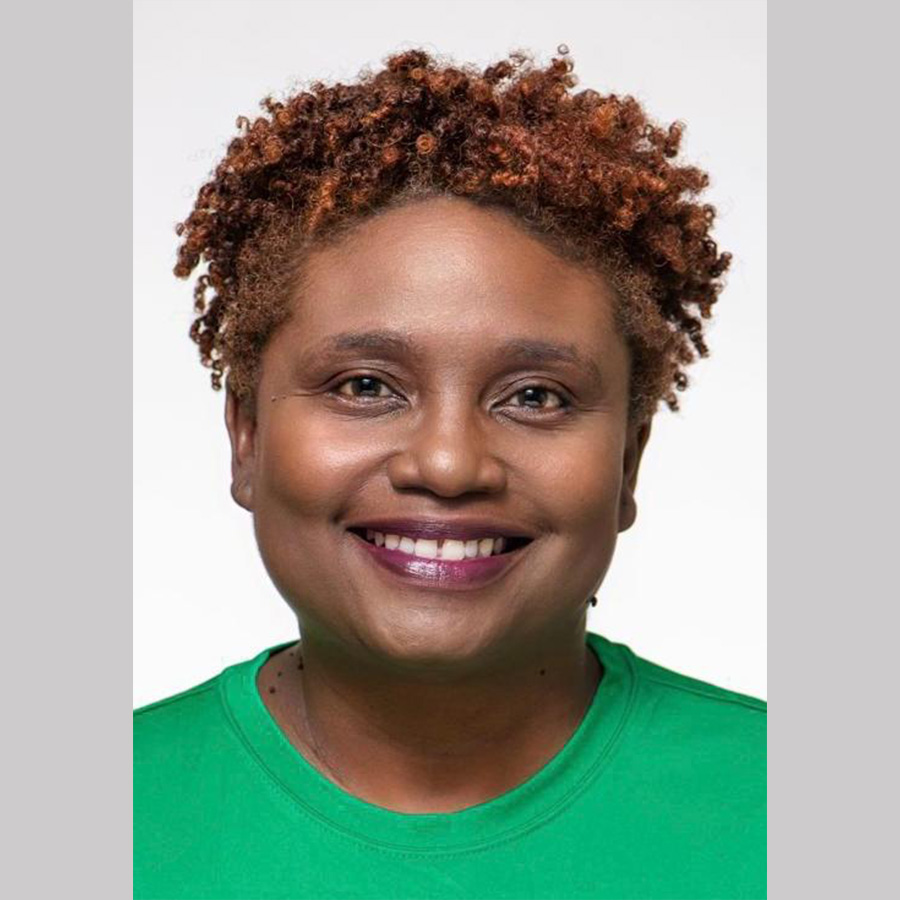
Actor, playwright, drama teacher, and organizational consultant
Master of Applied Positive Psychology, University of Pennsylvania ’25
Master of Science in Counseling and Psychology, Troy University ’98
Bachelor of Arts in Broadcast Journalism, Troy University ’97
“MAPP, for me, was a 20-year dream,” says Patrice Francis (Master of Applied Positive Psychology ’25). Patrice first encountered Penn’s Master of Applied Positive Psychology (MAPP) in her early years while working in Los Angeles as a facilitator for Wraparound, a care management process for youth in crisis. After serving as a guidance counselor in The Bahamas, she relocated to Los Angeles to pursue a PsyD in Clinical Psychology. “At the time, I had a master’s degree in psychology and general counseling, but I felt that I needed more tools to be able to help the population that I was serving,” she explains. “However, after one year, I realized that clinical psychology was not the best fit for me. Upon discovering the newly formed field of positive psychology I thought, if I ever go back to school, I'm going to go back for THAT! I was also convinced that if I was going to study positive psychology, I needed to study it at the University of Pennsylvania.” After years of delaying her application due to financial constraints, she finally applied and got accepted. As an international student, however, Patrice needed proof of funding in order to obtain immigration authorization to study in the United States. She was advised to apply for the Christopher Peterson Memorial Fellowship and subsequently won the award. “This fellowship was the key that opened up the door for me to come and subsequently change the trajectory of my life,” she says.
In the program, Patrice discovered more insight than she had dreamed. “I had been following positive psychology for years, but I had no idea about all of the ideas, constructs, and emerging practices that were associated with it,” she says. Beyond the ideas, there were also statistics and research based on real-life cases. She also found emotional and community support among her peers and instructors. “Academically, the stakes are pretty high. It is a graduate program at an Ivy League university, so there was a lot of work,” she laughs. “But they built these high-quality connections from the beginning, and other resources for whatever you needed. You just knew that you were not alone, and that made all the difference in the world.”
Patrice continued to work while completing her degree, teaching dramatic arts at Genesis Academy, a high school in Nassau. “I think my students could probably see the difference,” she muses. “I have the reputation of being an upbeat, positive kind of person, but I think it was exciting for them to see me go off and take classes and then come back and talk about it. In some cases, I was able to apply what I was learning right on the spot.” For example, Patrice was particularly struck by the concept of mattering, “which is where you feel valued and you also have the opportunity to add value,” she explains. “I saw over the years what service and responsibility did for the young people I work with. If you give them something to do, they feel good—and at the same time, what you’re doing is giving them an opportunity to add value. According to research, that’s mattering at its core.” After an on-site session on mattering, Patrice returned home and surveyed her students on the subject. “When I realized how many young people were dealing with the idea that they don’t matter and that their contributions don’t matter, I postured myself to listen to them on a deeper level and let them guide the work that we were doing.”
For example, she typically asked her drama students to work with scripts and memorize lines, but when she learned that they wanted to do more improvisation, she incorporated those activities into the class—and was deeply impressed with how quickly her students responded to complex scenarios devised during in-class performances. In another instance, she redirected the energies of a student whose talkative nature tended to be disruptive; placed in a directorial role, he became focused and inventive. “All of a sudden he’s not just a talkative kid; he’s taking something he can do and helping others,” she reflects. Helping her students identify how best they can contribute to the class—whether by writing, acting, or directing—also dovetails with strengths-based positive psychology interventions. “Even before I knew the term ‘strengths-based’, I’ve always been much more interested in what’s right with people than what’s wrong with them,” Patrice adds.
For her service learning project, Patrice collaborated with a group to create training materials for a returning MAPP partner, an agency that works directly with people with disabilities. “We designed curricula to help their staff use positive psychology constructs to enhance their conversations with their clients. Patrice describes this as a fulfilling experience that opened her eyes to how positive psychology applications can empower individuals from diverse backgrounds to exercise the agency necessary to position themselves in more favorable spaces and states.
During the year in MAPP, light was shed on another phenomenon that Patrice continues to examine and grapple with: The scarcity mindset. She had observed in her own community that poverty and other social challenges often condition students and even whole families to see limitations rather than opportunities. This pattern can be addressed—in part, at least—by psychological capital, or the presence of hope, efficacy, resilience, and optimism. “The acronym is HERO,” says Patrice. “My capstone project looked at how we can introduce these principles to young people who have a scarcity mindset.” Her project included a review of the research on psychological capital as well as videos—scripted by Patrice—designed for schoolchildren from 4th grade to 12th grade, in order to introduce them to the elements of psychological capital and develop strategies for developing a growth mindset. “Growing the good is not the same as fixing the bad,” she cautions. “But if we're going to flourish as human beings, we have to focus on the good as much as possible. And if we can increase hope, efficacy, resilience, and optimism in young people, we model for them how to turn ‘impossibilities’ into reality.”
Now that the “degree of her dreams” is complete, Patrice hopes to pilot her video series in under-resourced schools in The Bahamas, where she was born and raised. “This degree is for my country. It’s not for me,” she says. “And there are so many applications. I can’t do it all, of course, so I have to see where I can light a spark in others.” She continues to teach high school classes, exploring what a “positive theater” can look like—a performance arts space that centers around the strengths and needs of its people, helping them feel that they matter as they devise and produce positive works. She is also launching a podcast, “Still Better”. “It's going to be a clarion call to the people of The Bahamas, to highlight the ways in which we are thriving—because we're not going to get better by studying what's not working,” she says.